
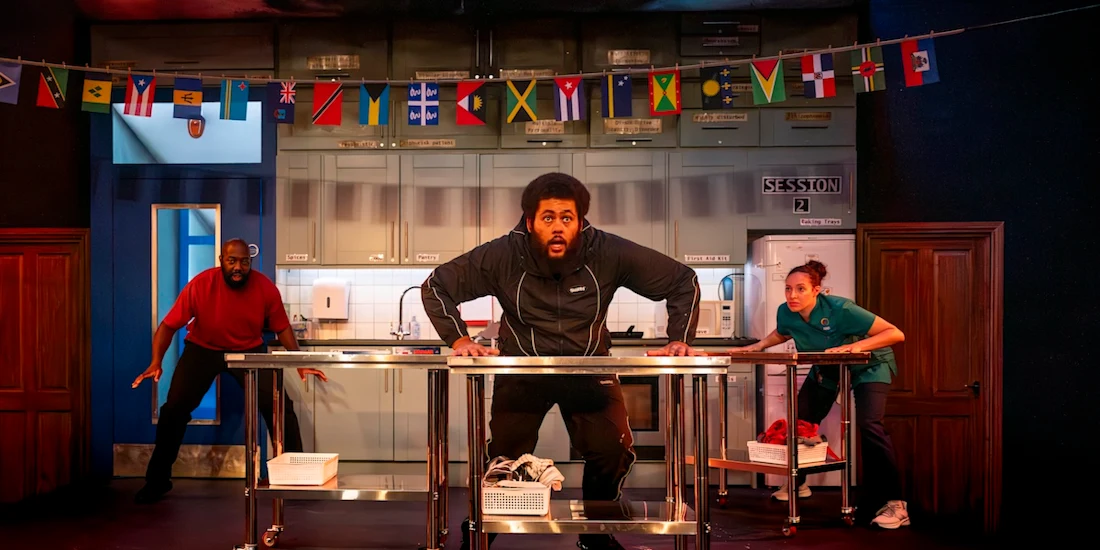
'After Sunday' review — this strong debut play addresses male mental health with humanity, empathy and humour
Read our review of Sophie Griffin's drama After Sunday, now in performances at the Bush Theatre to 20 December.

There is a saying that food is therapy. Bush Writers’ Group alum Sophie Griffin’s debut play, After Sunday, uses that premise to create a heartfelt and moving drama about four lives crossing over in a cooking class set up in a mental health hospital.
In this co-production with the Belgrade Theatre, we see Ty, Leroy and Daniel sign up to the Caribbean cooking class run by occupational therapist Naomi. Her aim is to engage and soothe the men with the memories and flavours of home. But as the sessions progress, tough truths are exposed and some traumas cannot be alleviated by making dumplings.
The cast of four has wonderful rapport. Aimée Powell shows endless patience, tolerance and kindness as Naomi, even as she is gradually stretched to breaking point herself thanks to dwindling support in her home life and constant challenges from the hospital’s management.
Corey Weekes is full of banter and bravado as Ty, the youngest member of the group. Weekes vividly captures this often immature man, quick to anger and in denial that he is battling with his own traumas. As Daniel, Darrel Bailey is full of quiet determination to get through his situation. His focus is his family and he is tortured by being denied access to his children. Bailey supplies a very nuanced study of anxiety and acute mental distress.
Playing the elder of the group, David Webber is hugely likeable as Leroy. This affable man is revealed to have done a horrendous thing, but also shows vulnerability and high levels of sensitivity, particularly when he begins to speak about his estranged daughter.

Griffin’s writing effectively focuses on the mundane, rather than the sensational. Smaller events become hugely significant, such as the group cooking for the upcoming ‘friends and family day’, or Daniel’s desire to bake his daughter a birthday cake. When there are interruptions or changes to what is hoped for or expected, that is when things start to crumble.
The production could easily veer into unremitting bleakness, but Griffin adds in a healthy dose of wit and wry humour. It is just enough to create moments of levity, but not too much to detract from the severity of the subject.
Director Corey Campbell punctuates the scenes with moments of stuttering, tormented movement, as though reflecting the characters’ inner pressures and pain. These instances are enhanced hugely by Xana’s discordant sound design, combined with Ali Hunter’s dramatic lighting.
Claire Winfield’s set is deceptively simple: a raised platform housing an ordered kitchen, with box folders of medical case notes underneath. The locked kitchen cupboards feature clean white labels, detailing their contents, but on closer inspection you can see that the upper cupboards have dirty, yellowing labels, listing various mental health conditions. A large, black-stained sheet hangs above the set, reminiscent of the psychological Rorschach inkblot test or perhaps dark clouds swirling above.
The Bush has done a huge amount to bring attention to the mental health struggles of the Black community. After Sunday continues this vital work by addressing these issues with humanity, empathy and humour. A thoughtful and compassionate debut.
After Sunday is at the Bush Theatre to 20 December. Book After Sunday tickets on LondonTheatre.co.uk
Photo credit: After Sunday (Photos by Nicola Young)
Originally published on